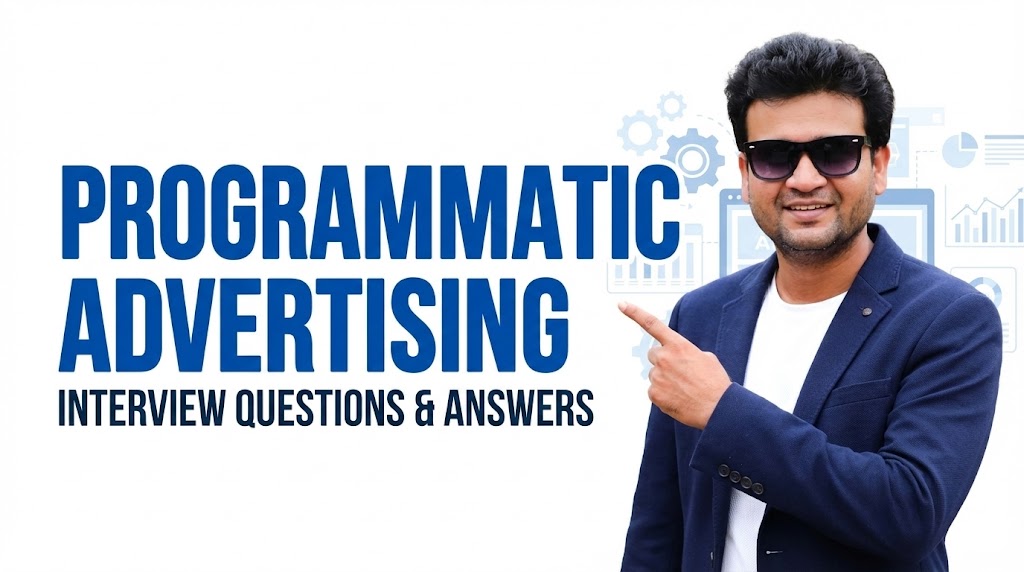
Programmatic Advertising Interview Questions and Answers (2026)
1. What is programmatic advertising?
Answer
Programmatic advertising is the automated buying and selling of digital ad inventory using data, algorithms, and real-time auctions. It allows advertisers to target the right audience, at the right time, on the right platform, without manual negotiations.
Example
When a user visits a website, an auction happens in milliseconds and the highest relevant bid wins the ad placement.
2. How does programmatic advertising work?
Answer
Programmatic works through a real-time bidding (RTB) process:
• User visits a site or app
• Ad request is sent to an exchange
• DSPs evaluate the user data
• The highest eligible bid wins
• The ad is served instantly
All this happens in under 100 milliseconds.
3. What are the main components of the programmatic ecosystem?
Answer
• Advertiser
• Agency
• DSP (Demand-Side Platform)
• SSP (Supply-Side Platform)
• Ad Exchange
• Publisher
• Data providers
• Measurement and verification tools
Each component plays a role in buying, selling, or measuring ads.
4. What is a DSP?
Answer
A DSP is a platform that allows advertisers to buy digital ad inventory programmatically across multiple publishers and exchanges using targeting, bidding, and optimization tools.
Example
DV360, The Trade Desk, Amazon DSP.
5. What is an SSP?
Answer
An SSP helps publishers manage, sell, and optimize their ad inventory by connecting it to multiple ad exchanges and DSPs.
Example
Magnite, PubMatic, OpenX.
6. What is Real-Time Bidding (RTB)?
Answer
RTB is an auction-based process where advertisers bid in real time for each ad impression. The auction occurs when a user loads a page, and the winning bid serves the ad.
7. What is the difference between Open Exchange and PMP?
Answer
• Open Exchange: Open auction, wider reach, lower CPM, less control
• PMP (Private Marketplace): Invite-only, premium inventory, higher CPM, better control and brand safety
8. What are Programmatic Guaranteed deals?
Answer
Programmatic Guaranteed deals are pre-negotiated agreements where inventory, price, and volume are fixed, but delivery happens programmatically.
Use case
High-impact brand campaigns with guaranteed impressions.
9. What is header bidding?
Answer
Header bidding allows multiple SSPs to bid simultaneously for an impression before the ad server decision, increasing competition and publisher revenue.
10. What is brand safety in programmatic advertising?
Answer
Brand safety ensures ads do not appear next to inappropriate or harmful content. It is managed through:
• Content exclusions
• Pre-bid and post-bid filters
• Third-party verification tools
11. What is brand suitability?
Answer
Brand suitability is a more flexible version of brand safety. It allows brands to define what content is acceptable based on their values and risk tolerance rather than blocking broad categories.
12. What targeting options are available in programmatic advertising?
Answer
• Demographic targeting
• Geographic targeting
• Contextual targeting
• Behavioral targeting
• First-party audiences
• Lookalike audiences
• Device and time-based targeting
13. What is first-party data and why is it important in 2026?
Answer
First-party data is data collected directly from users by a brand, such as website visits or CRM data.
In a cookieless world, first-party data is critical because it is privacy-safe, accurate, and future-proof.
14. How has programmatic advertising changed due to privacy regulations?
Answer
Key changes include:
• Reduced reliance on third-party cookies
• Increased use of contextual targeting
• Modeled conversions and attribution
• Clean rooms for data collaboration
• Consent-based data collection
15. What is a cookie and why are third-party cookies being phased out?
Answer
A cookie is a small file stored on a user’s browser to track behavior. Third-party cookies are being phased out due to privacy concerns, leading to new targeting and measurement solutions.
16. What KPIs are important in programmatic advertising?
Answer
Depends on campaign goal:
• Awareness: Reach, Frequency, CPM, VTR
• Consideration: CTR, Engagement rate
• Performance: CPA, ROAS, CVR
• Quality: Viewability, IVT
17. What is viewability and why does it matter?
Answer
Viewability measures whether an ad was actually seen by a user.
An ad is considered viewable if:
• Display: 50% pixels visible for 1 second
• Video: 50% pixels visible for 2 seconds
Higher viewability improves brand impact and performance.
18. How do you optimize a programmatic campaign?
Answer
• Analyze performance by audience, inventory, and creative
• Exclude low-quality placements
• Adjust bids and budgets gradually
• Refresh creatives to avoid fatigue
• Optimize frequency and targeting
19. What is frequency capping?
Answer
Frequency capping limits how many times a user sees the same ad within a set time period, preventing overexposure and ad fatigue.
20. What is attribution in programmatic advertising?
Answer
Attribution assigns credit to different touchpoints in a user’s conversion journey. In 2026, attribution relies more on modeled data rather than user-level tracking.
21. What tools are used for measurement and verification?
Answer
• Google Analytics 4
• Campaign Manager 360
• IAS
• DoubleVerify
• MOAT
22. What challenges do advertisers face in programmatic advertising?
Answer
• Ad fraud
• Brand safety risks
• Data privacy regulations
• Measurement limitations
• Inventory quality issues
23. How do you explain programmatic advertising to a non-technical client?
Answer
Programmatic advertising is like buying ads automatically, where computers decide which ad to show to which person, at the best price, in real time.
24. How do you handle ad fraud in programmatic campaigns?
Answer
• Enable pre-bid IVT filters
• Use third-party verification tools
• Exclude suspicious apps and sites
• Monitor abnormal CTR or traffic patterns
25. What skills are important for a programmatic professional in 2026?
Answer
• Data analysis
• Platform knowledge
• Privacy awareness
• Strategic thinking
• Clear communication
Scenario-Based Programmatic Interview Questions (2026)
Scenario 1: Campaign Spending but Not Converting
Question
A programmatic campaign is spending consistently, but conversions are close to zero. How do you troubleshoot?
Answer
• First validate conversion tracking (GA4, Floodlight, consent mode)
• Check attribution window and conversion delay
• Review audience intent vs campaign objective
• Analyze landing page experience and load time
• Inspect inventory quality at site/app level
Scenario 2: CPA Suddenly Spikes After Scaling
Question
CPA was stable, but after increasing the budget, it spiked. What went wrong?
Answer
• Budget increase may have reset learning
• Frequency likely increased too quickly
• Lower-quality inventory entered the auction
• Bids may no longer be competitive for high-quality supply
Fix
• Roll back scale partially
• Apply frequency caps
• Tighten inventory and audience filters
Scenario 3: PMP Under-Delivering
Question
A PMP deal is delivering only 40% of expected impressions. What do you do?
Answer
• Check bid competitiveness vs floor price
• Review targeting conflicts
• Confirm publisher availability
• Adjust time-of-day bidding
• Activate backup PMPs or Open Exchange
Scenario 4: High CTR but Poor Lead Quality
Question
CTR looks great, but the client complains about poor lead quality. Why?
Answer
• Clickbait creatives attracting wrong intent
• Over-reliance on mobile app inventory
• Audience too broad or misaligned
• Weak landing page qualification
Scenario 5: Brand Safety Incident Reported
Question
A client reports ads appearing on an unsafe site. How do you respond?
Answer
• Pause affected line item immediately
• Identify placement via reporting
• Apply domain/app exclusions
• Review brand suitability settings
• Share corrective actions transparently with client
Fresher vs Manager Answers (Programmatic)
Question: How do you optimize a programmatic campaign?
Fresher Answer
I monitor key metrics like impressions, clicks, and conversions. Based on performance, I adjust bids, pause low-performing placements, and test new creatives to improve results.
Manager Answer
I optimize at three levels: audience, inventory, and creative. I analyze trends across time windows, identify efficiency drivers, and make controlled changes to scale performance without disrupting learning or KPIs.
Question: How do you decide which inventory to use?
Fresher Answer
I start with Open Exchange and apply brand safety filters and targeting options.
Manager Answer
I evaluate inventory based on performance, viewability, brand safety, and scale. I use Open Exchange for discovery and PMPs or Programmatic Guaranteed for quality and consistency.
Question: How do you handle privacy changes in programmatic?
Fresher Answer
I follow GDPR guidelines and ensure consent is taken before tracking.
Manager Answer
I prioritize first-party data, contextual targeting, modeled conversions, and consent-based measurement. I design campaigns assuming limited user-level data.
Real Programmatic Case Studies with Metrics
Case Study 1: CPA Reduction in Lead Generation
Objective
Reduce CPA without losing volume
Channel
Programmatic Display
Initial Metrics
• CPA: $140
• Daily Spend: $15,000
Actions Taken
• Removed low-quality app inventory
• Shifted to contextual + first-party audiences
• Optimized frequency caps
• Introduced new creatives
Results
• CPA reduced to $95
• Conversions increased by 24%
Case Study 2: Scaling Awareness Campaign Safely
Objective
Increase reach without over-frequency
Channel
Programmatic Video + CTV
Initial Metrics
• Reach: 1.2M
• Frequency: 3.8
Actions Taken
• Applied strict frequency caps
• Optimized placements
• Rotated creatives
Results
• Reach increased to 2.1M
• Frequency reduced to 2.6
• View rate improved by 17%
Case Study 3: Fixing Under-Delivering PMP
Objective
Achieve planned delivery
Channel
Private Marketplace
Initial Metrics
• Delivery: 45%
• CPM: $9
Actions Taken
• Increased bids during peak hours
• Activated additional PMPs
• Reduced targeting overlap
Results
• Delivery improved to 92%
• CPA remained stable
One-Page Programmatic Interview Cheat Sheet (2026)
Core Concepts
• Programmatic = automated ad buying
• RTB = real-time auction per impression
• DSP buys, SSP sells
Inventory Types
• Open Exchange – scale
• PMP – quality + control
• Programmatic Guaranteed – certainty
Key KPIs
• Awareness: Reach, CPM, VTR
• Performance: CPA, ROAS, CVR
• Quality: Viewability, IVT
Optimization Framework
• Audience → Inventory → Creative
• Scale gradually (10–20%)
• Watch frequency before budget increases
Privacy Focus
• First-party data
• Contextual targeting
• Modeled conversions
• Consent-based tracking
Interview Golden Rule
Always explain answers using:
Objective → Problem → Action → Result
For DV 360 Interview questions and Answers please visit here!